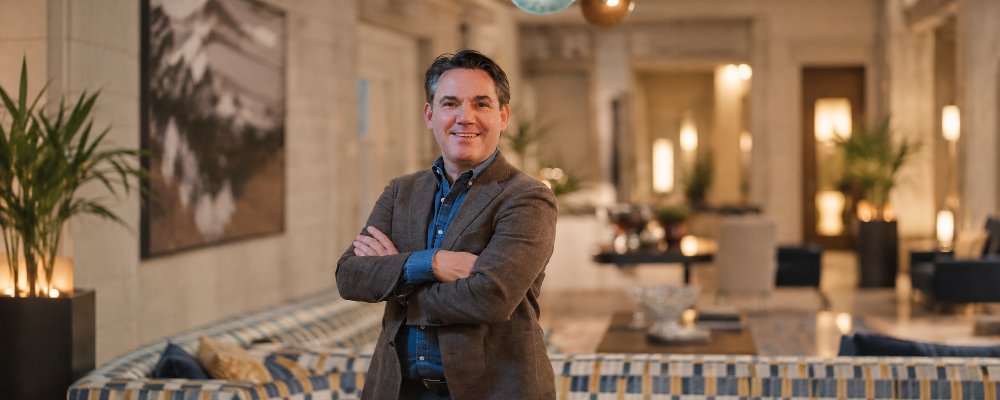
John Nieuwland: from Sudan to Amsterdam, and from ambition to people-focused leadership
John Nieuwland didn't always know he wanted to work in hospitality. While studying economics, he discovered what was missing: a dynamic environment, interaction with people and a workplace where no two days are the same. A part-time job at a hotel changed his direction and eventually led him to Hotelschool The Hague.
Since then, he has worked in the Netherlands, Sudan, Egypt and Turkey, built his career in Food & Beverage and progressed to General Manager and Regional Director of Operations. Today, he is back at the heart of daily hotel operations as General Manager of The Hoxton, Lloyd Amsterdam.
His career shows not only how many opportunities the hospitality industry offers, but also how his perspective on leadership has evolved. While his focus used to be on the next career move, John now places much greater importance on workplace culture, developing people and working together to make a hotel better.
A part-time hotel job changed my career
I didn't grow up knowing I wanted to work in hospitality. I started studying economics in Rotterdam, but quickly realised that the theoretical approach wasn't right for me. I missed interacting with people and, above all, the dynamic environment.
During my studies, I started working at a hotel in Spijkenisse. That was my first real introduction to hospitality, and I discovered that this industry suited me much better. I left my degree programme and enrolled at Hotelschool The Hague. That's where my career really began.
F&B taught me how a hotel really works
During hotel school, I spent a lot of time working in Food & Beverage. I made a conscious effort to gain experience on the rooms side as well, including through internships and a traineeship. But every time, I found myself missing the pace and energy of F&B.
That foundation has been incredibly important throughout my career. In F&B, you're constantly dealing with guests, quality, revenue and productivity. When something goes wrong, you can't always leave the problem until tomorrow. You have to respond, make decisions and find solutions.
In many ways, F&B brings together almost everything you need later as a General Manager, but on a smaller scale. You learn to think commercially, act operationally and work with people at the same time.
Working in Sudan changed my perspective on leadership
In my late twenties, I had the opportunity to work as an F&B Manager during the opening of a hotel in Sudan. I deliberately wanted to gain international experience, although Sudan wasn't exactly a destination I had imagined for myself.
It was a challenging environment where even electricity and running water couldn't be taken for granted. I learned to improvise, put things into perspective and find creative ways to deal with limitations.
It also changed the way I thought about leadership. Hierarchies and communication styles were different from those in the Netherlands. I discovered that you can't manage people the same way everywhere. You need to understand what motivates someone and adapt your approach accordingly. That's a lesson I still apply in the international hotel industry today.
After Sudan, I worked in Egypt and briefly in Turkey before returning to the Netherlands. I wouldn't rule out working abroad again, but these days, personal considerations would play a much bigger role in that decision.
Leaving hospitality made me realise why I missed hotels
After returning to the Netherlands, I deliberately spent some time working outside the hotel industry. Hotels operate 24/7, and I wanted to experience what it would be like to have a job with a more regular schedule. I moved into corporate catering, where the working week was much more Monday to Friday.
I enjoyed it, but I missed the dynamics of hotel life. Afterwards, I also worked in the restaurant industry, but I found that too limited in scope. Eventually, I realised that it's precisely the diversity of hotel operations that appeals to me.
One day you're dealing with finance or revenue management, the next with operations or people. Running a hotel almost feels like running your own business. That variety is exactly what keeps me interested in the industry, even after more than 25 years.
A good GM doesn't need to be the expert in everything
As a General Manager, you need to see a hotel as a business and understand how all its departments and disciplines work together. But that doesn't mean you need to be the greatest expert in every field.
In fact, the people around you can help you move forward. These days, for example, I also work with external specialists in marketing and People & Culture. Earlier in my career, I would have been more inclined to think that, as a director, I needed to solve everything myself.
Now, I'm more likely to ask myself: what expertise do we need to take the hotel forward?
Sometimes, that means not coming up with the answer yourself but bringing in someone who knows more about a particular subject.
For me, leadership is becoming less about having all the answers and more about creating an environment where people feel confident taking responsibility, supporting one another and developing their skills. Ultimately, as a General Manager, you're only as good as the team you build around you.
Creating a strategy is easy. Getting people on board is the real challenge
What I still enjoy most about being a General Manager, even after all these years, is the variety and, above all, working with a team to develop a shared vision. Where do we want to go? Where are the opportunities? And how do we turn those opportunities into a strategy?
Putting a strategy on paper isn't particularly difficult. The real work starts afterwards. You have to keep assessing whether your plans still reflect what's happening around you and be willing to adjust your approach.
The world changes too quickly to do otherwise. What works today might not work tomorrow. For me, that's what makes the GM role so interesting: setting a direction, translating it into concrete decisions and bringing a team together to turn that vision into reality.
From managing six hotels back to one
In my previous role, I was Regional Director of Operations, responsible for six hotels. Over time, I realised that what really gives me energy is being directly involved in developing a hotel, improving the guest experience and working with the team. I wanted to be closer to daily operations again and build something together with the people working there.
Of course, financial performance is essential. A hotel needs to be commercially healthy. But ultimately, we're still in the hospitality business.
So when I decided to return to managing a single hotel, there was one thing I knew for certain: I wanted to work for an organisation where genuine hospitality came first. That's how I ended up at The Hoxton.
Both The Hoxton and the Lloyd should have their own presence
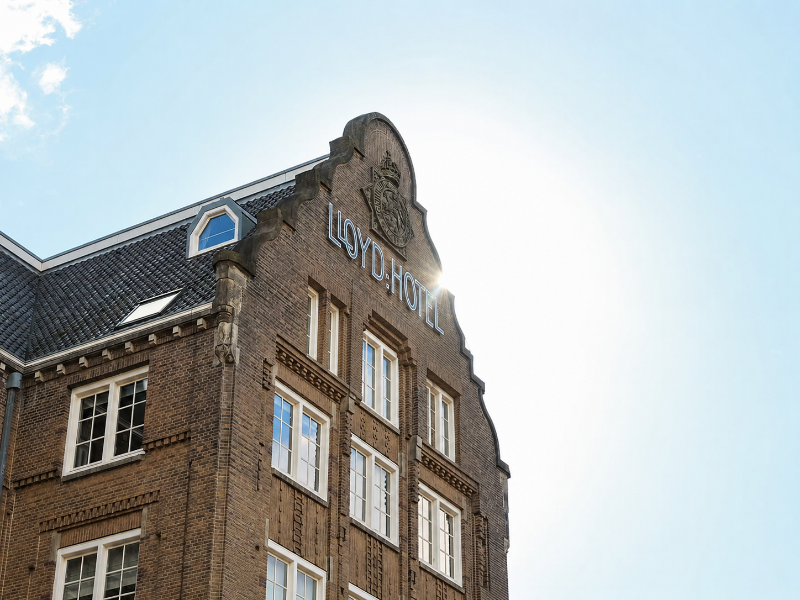
Over the coming years, I want to strengthen the position of The Hoxton, Lloyd Amsterdam and give the hotel an even clearer identity in Amsterdam East.
I want to bring two worlds together. On one side, there's The Hoxton, with its informal atmosphere, genuine hospitality and the feeling that everyone is welcome. On the other, there's the Lloyd building, with its own history and character.
When guests walk through the door, I want them to experience both. They should immediately recognise that they're at The Hoxton, while also feeling that this particular location is unique.
The Lloyd isn't a standard hotel. The building has a remarkable history and a character of its own. My ambition is to connect that identity even more strongly with the energy and hospitality of The Hoxton.
We don't just want to be a hotel where people stay overnight. We also want to be a place where the local community enjoys coming together and where guests can experience something of Amsterdam itself.
Guests already know your hotel before they arrive
One of the biggest changes in the past 25 years is how much more transparent the hotel industry has become.
In the past, you might visit a hotel or restaurant without knowing exactly what to expect. Today, guests have often already seen everything through websites, reviews, Instagram and other social media before they even walk through the door.
That makes it harder to genuinely surprise people. At the same time, this transparency has helped raise the overall standard of hotels. A poor room or bad service doesn't stay hidden for long.
As a result, one question has become increasingly important: why should a guest choose your hotel over another?
For The Hoxton, the answer lies partly in its design, its connection to the local community and its genuine, personal approach to hospitality.
The more we automate, the more valuable human interaction becomes
Technology has transformed the hotel industry. From bookings and revenue management to social media and AI, almost everything is digital these days.
And yet, at The Hoxton, we deliberately choose not to fully automate the check-in experience. Technology should make a guest's stay easier, but personal interaction remains essential.
Self-check-in might make perfect sense at an airport hotel, but guests at a lifestyle hotel expect something more.
In a world where more and more processes are being automated, genuine human hospitality is becoming an increasingly important way to stand out.
A future-proof hotel needs to keep adapting its strategy
For me, a future-proof hotel is both commercially healthy and relevant to its guests.
You need to keep asking yourself whether what you're doing still matches the needs of your target audience. Why should guests choose us? And is the answer still the same as it was a few years ago?
I believe the days of creating a five-year plan and simply following it are behind us.
You need a clear vision, but the strategy supporting that vision must be flexible enough to evolve with your guests, the market and the world around you.
Success isn't about your next job title
Earlier in my career, I was mainly focused on my next step. I wanted to become a director and, after that, a Regional Director.
Today, I care much more about the culture I work in, how I continue to develop myself and what opportunities I can create for others.
One example that stands out is the opening of a 250-room hotel in Rotterdam, which was fully occupied within a week. That was incredibly rewarding, especially because we had achieved it together.
It was the collective achievement that made it so special: working towards something as a team and then seeing what you've managed to build together.
For me, success is now about both commercial results and developing people.
Ultimately, I want to be able to look back at what we've built as a team and how we've taken the hotel to the next level together.
A successful hotel isn't just one that performs well financially. It's also a place where employees enjoy their work, have opportunities to develop and feel proud of what they've achieved together.
Inspired by John Nieuwland's story? Your next career move could be at The Hoxton, Lloyd Amsterdam! Explore the job opportunities at The Hoxton, Lloyd Amsterdam and become part of the team.