
Hotel candidates apply most often on Tuesdays and Thursdays around 11:00 a.m.

Anyone looking to advertise hotel vacancies effectively should consider not only what is written in the job description, but also when candidates are actually active. Based on Hotelprofessionals’ own data and Google Trends insights, a clear pattern emerges: the best moments to attract applicants are not randomly spread throughout the week or year.
Hotelprofessionals' data shows that 11:00 a.m. is the most popular time of day for candidates to submit applications. Tuesdays and Thursdays also stand out as days when candidates are more likely to respond. This suggests that application behaviour is closely linked to moments when people have the time and focus to think about their next career move.
For hotels, this is highly relevant because vacancies are often published at random times. In a tight labour market, poor timing can unnecessarily limit visibility and reach. Employers who publish or promote vacancies when candidates are demonstrably more active increase their chances of attracting attention and receiving applications.
January remains the strongest month
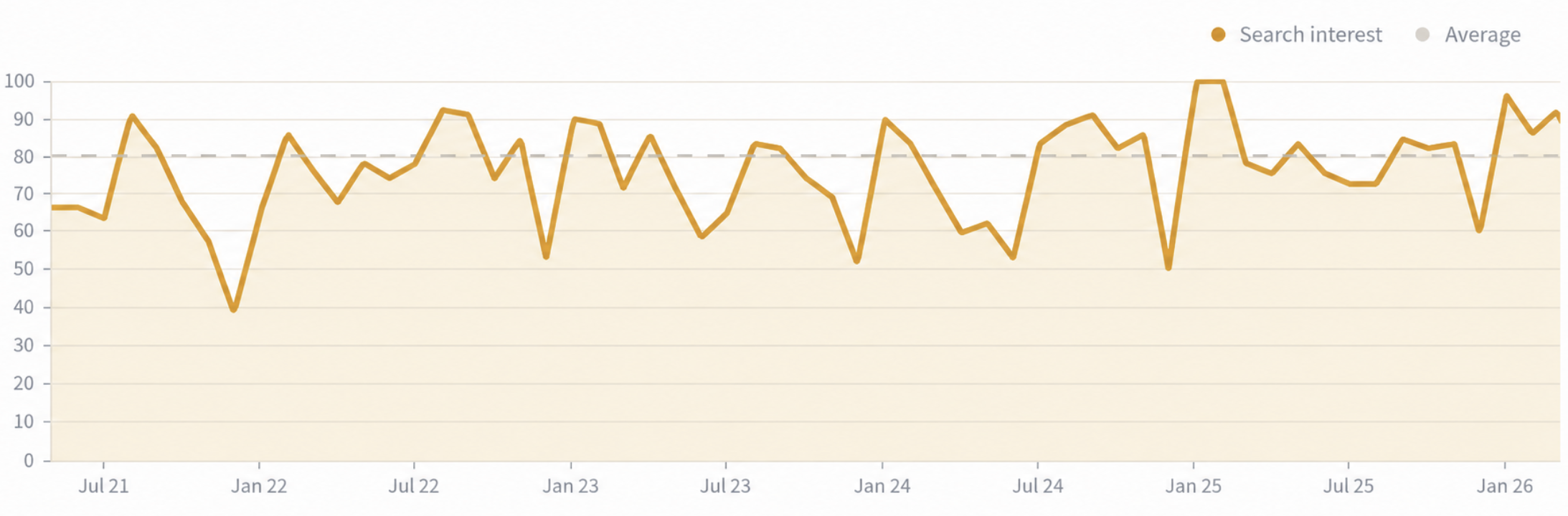
The monthly trends reveal a similarly clear pattern. According to Google Trends data analysed by Hotelprofessionals, January is consistently the most popular month for interest in hotel jobs. In 2025, search interest reached the maximum score of 100 in both January and February. January 2026 remained exceptionally strong with a score of 97.
This aligns with a well-known labour market trend: the beginning of the year is often a period of reflection and reorientation for professionals. New goals, fresh plans and evaluations of current roles create increased movement in the job market. For hotel employers, this means that January and February are not only busy operational months but also key recruitment periods.
Month of the year
Day of the week

December is consistently quieter
In contrast to the peak at the beginning of the year, December shows a consistent decline in interest. Across multiple years, the trend data indicates significantly lower levels of interest compared to January, February and often September or November.
This does not necessarily make December a poor month for recruitment, but it is less suitable for a volume-driven hiring strategy. Instead, hotels can use December to focus on preparatory activities such as employer branding, talent pool development, content planning and preparing campaigns for the new year.
Late summer and early autumn also show strong activity
Beyond the strong start to the year, August and September stand out in several years as periods with relatively high search interest. In 2021, 2022 and 2024, these months clearly outperformed many other periods of the year.
This suggests that January is not the only important recruitment period. The post-summer phase also represents a significant opportunity. For the hotel industry, this is particularly interesting. As seasonal work winds down, employees reassess their work-life balance and candidates begin looking ahead to new opportunities. Hotels that only start thinking about recruitment in autumn may already be behind.
Recruitment requires rhythm, not just reach
The data shows that recruitment is increasingly about rhythm and consistency. Not every weekday performs equally well, not every hour offers the same opportunity, and not every month requires the same approach. As a result, hotel recruitment benefits less from one-off job postings and more from a structured publishing schedule aligned with candidate behaviour.
In practical terms, this means publishing or boosting vacancies on Tuesdays or Thursdays whenever possible, building visibility towards the 11:00 a.m. peak period, and scheduling major recruitment campaigns during January, February and the period following the summer holidays. Timing then becomes an active part of recruitment strategy rather than an afterthought.
Hotel employers can act on these insights immediately
For HR teams and recruiters in hospitality, the value of these insights lies in their practical application. Unlike broader labour market trends such as talent shortages or skills gaps, these behavioural patterns can be directly translated into day-to-day recruitment activities.
When should a vacancy be published? When should a newsletter be sent? When is the best time for social media posts, job alerts and remarketing campaigns?
In a market where qualified candidates are scarce, these details can make a real difference. Timing will not fix a weak vacancy, but a strong vacancy published at the right moment simply has a better chance of being seen and acted upon.
Recruitment is becoming increasingly behaviour-driven
The conclusion from the data is clear: candidates follow recognisable behavioural patterns. For hotel employers looking to professionalise their recruitment processes, this presents a tangible opportunity. Less broadcasting at random moments and more planning based on actual candidate behaviour.
This approach not only improves efficiency but also sharpens recruitment performance. In a market where every relevant application matters, the question is no longer just who you want to reach, but also when you are most likely to reach them.