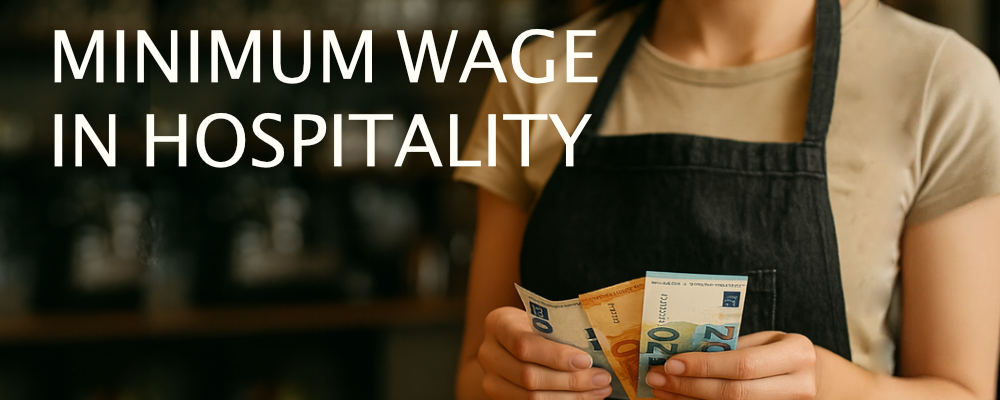
Minimum wage in Dutch hospitality in 2026

Employees working in the Dutch hospitality industry are entitled to at least the statutory minimum hourly wage or, if higher, the minimum wage stated in the Hospitality Industry Collective Labour Agreement.
The amount you must receive depends on several factors, including your age, whether you qualify as a skilled employee, your job category and whether you are following a work-based vocational training programme.
As of 1 July 2026, the statutory minimum hourly wage for employees aged 21 and over is €14.99 gross per hour. Different statutory youth rates apply to employees aged 15 to 20.
This information is based on the statutory minimum wage rates and the Dutch Hospitality Industry Collective Labour Agreement 2025-2026.
Statutory minimum wage from 1 July 2026
The Dutch government adjusts the statutory minimum wage twice a year: on 1 January and 1 July.
The following gross minimum hourly wages apply from 1 July 2026:
Age | Statutory minimum hourly wage |
|---|---|
21 and over | €14.99 |
20 | €11.99 |
19 | €8.99 |
18 | €7.50 |
17 | €5.92 |
16 | €5.17 |
15 | €4.50 |
These are gross amounts before wage tax and other statutory deductions.
Minimum wage from 1 January to 30 June 2026
The following statutory hourly rates applied during the first half of 2026:
Age | Statutory minimum hourly wage |
|---|---|
21 and over | €14.71 |
20 | €11.77 |
19 | €8.83 |
18 | €7.36 |
17 | €5.81 |
16 | €5.07 |
15 | €4.41 |
If you check a payslip from the first half of 2026, use the January rates. For hours worked from 1 July 2026 onwards, use the July rates.
Does the statutory minimum wage apply to 20-year-olds?
Yes, but a 20-year-old is still covered by the statutory youth minimum wage. From 1 July 2026, the statutory minimum for a 20-year-old is €11.99 gross per hour.
However, the Hospitality Industry Collective Labour Agreement may provide a considerably higher minimum wage. A 20-year-old who qualifies as a skilled employee is considered an adult employee for the purpose of the CLA wage table and is entitled to 100% of the basic wage for the applicable job category.
A 20-year-old skilled employee may therefore be entitled to at least €14.99 per hour or more, even though the statutory youth minimum wage is only €11.99.
Statutory minimum wage versus the Hospitality CLA wage
The statutory minimum wage is the absolute legal minimum. If the Hospitality Industry Collective Labour Agreement applies to your employer, the employer must also comply with the CLA wage table.
The applicable CLA wage may be higher than the statutory minimum. Your employer must pay whichever minimum amount is higher in your situation.
Your wage under the Hospitality CLA depends on:
whether you are a skilled or non-skilled employee;
your age;
your job category;
whether you are a BBL student;
any more favourable agreements in your employment contract.
What is a skilled employee under the Hospitality CLA?
The CLA uses the term skilled employee for an employee who meets the applicable qualification or experience requirements for the position.
You may qualify as a skilled employee if, for example, you have a recognised vocational diploma for the job. Relevant practical experience may also result in skilled-employee status under the conditions stated in the CLA.
Your status matters because skilled employees are paid according to the basic wage of their job category rather than the lower table for non-skilled employees.
Do not assume that every employee aged 20 or over automatically qualifies as a skilled employee. Age and skilled-employee status are separate conditions.
Minimum CLA wages for skilled employees from 1 July 2026
A skilled employee aged 20 or over is entitled to 100% of the basic wage for the applicable job category.
Job category | Basic hourly wage from 1 July 2026 |
|---|---|
I and II | €14.99 |
III | €14.99 |
IV | €14.99 |
V | €15.21 |
VI | €16.07 |
VII | €17.61 |
VIII | €19.29 |
IX | €21.02 |
X | €22.91 |
XI | €24.98 |
These are the basic wages. Your actual wage may be higher because of previous salary agreements, performance-based pay, company policies or an individually negotiated salary.
Wages for skilled employees aged 18 and 19
Under the Hospitality CLA, younger skilled employees receive a percentage of the basic wage for their job category:
19-year-old skilled employee: at least 90% of the applicable basic wage;
18-year-old skilled employee: at least 80% of the applicable basic wage.
For example, the minimum basic hourly wage in job categories I to IV is €14.99 from 1 July 2026. This results in:
€13.49 per hour for a 19-year-old skilled employee;
€11.99 per hour for an 18-year-old skilled employee.
Higher amounts apply in the higher job categories.
Minimum CLA wages for non-skilled employees
The Hospitality CLA also contains a separate youth scale for employees who do not yet qualify as skilled employees. These CLA percentages are more favourable than the statutory youth minimum wage percentages.
The following minimum hourly wages apply to non-skilled employees in job categories I and II from 1 July 2026:
Age | CLA percentage | Minimum hourly wage |
|---|---|---|
21 and over | 100% | €14.99 |
20 | 85% | €12.74 |
19 | 75% | €11.24 |
18 | 65% | €9.74 |
17 | 55% | €8.24 |
16 | 45% | €6.75 |
15 | 35% | €5.25 |
This means that a non-skilled 20-year-old covered by the Hospitality CLA is entitled to at least €12.74 per hour from 1 July 2026. A 20-year-old skilled employee is entitled to at least the full basic wage of the applicable job category.
What do BBL students earn?
BBL stands for beroepsbegeleidende leerweg, a work-based vocational training programme in which the student combines employment with education.
The Hospitality CLA applies its more favourable youth percentages to qualifying BBL students. The wage table therefore differs from the standard statutory BBL minimum-wage table.
The precise amount depends on the student’s age, contracted hours and the applicable CLA table. Employers and students should use the current Hospitality CLA wage table rather than relying only on the general statutory BBL rates.
Is there a fixed minimum monthly wage?
No. Since 1 January 2024, the Netherlands has had a statutory minimum hourly wage. There is no longer one fixed statutory minimum monthly, weekly or daily wage.
Your minimum monthly wage depends on the number of hours for which you are entitled to wages in that month. This may include:
hours actually worked;
paid holiday hours;
hours during which you were ill and entitled to continued payment;
other hours that legally count as paid working time.
The Hospitality CLA uses an annual-hours system of 1,976 hours for a standard full-time employee, equivalent to an average of 38 hours per week.
The monthly amounts in the CLA wage table are calculated using the following formula:
1,976 annual hours ÷ 12 × applicable hourly wage
If you work more than the agreed annual hours, those additional hours must also be compensated in accordance with the CLA and must never be paid below the applicable statutory minimum hourly wage.
Why does the minimum hourly wage no longer depend on a 36- or 38-hour week?
Before 2024, the statutory minimum wage was expressed mainly as a monthly amount. This meant that the derived hourly wage could differ depending on whether a sector used a 36-, 38- or 40-hour working week.
Since 1 January 2024, one statutory minimum hourly wage applies to employees aged 21 and over, regardless of the standard full-time working week in their sector.
The current statutory hourly wage is therefore not calculated separately on the basis of a 36-hour week. The Hospitality CLA still uses an average 38-hour working week for its annual-hours and monthly-wage calculations.
Do tips count towards the minimum wage?
Tips are not a safe substitute for the wage your employer is required to pay. Your employer remains responsible for ensuring that you receive at least the applicable statutory and CLA wage.
Whether tips can form part of your agreed remuneration depends on the arrangements between employer and employee and on how the tips are distributed. An employer cannot simply reduce your contractual wage because guests may leave tips.
Check that your payslip shows at least the correct contractual hourly wage before tips. Tips should normally be treated as additional income rather than as a guaranteed replacement for your basic wage.
Read more about tips in the hospitality industry.
Are night, weekend and public-holiday premiums included?
The minimum wage and the basic CLA wage do not automatically include every possible allowance. Separate arrangements may apply to public holidays, overtime, on-call duties or company-specific premiums.
The Hospitality CLA does not provide a general automatic premium simply because you work in the evening, at night or during the weekend. More favourable arrangements may be included in your employment contract, staff handbook or company policy.
How can you check whether your wage is correct?
Check the following information:
your age on the date the hours were worked;
whether the statutory January or July rate applies;
whether the Hospitality CLA applies to your employer;
whether you are classified as a skilled or non-skilled employee;
your job category;
your gross hourly wage;
the number of paid hours on your payslip;
any additional hours, overtime or allowances.
Your employer must provide a payslip showing how your gross wage has been calculated. Compare the gross hourly wage on that payslip with the current statutory and CLA wage tables.
What can you do if you are paid too little?
First ask your employer or payroll department for a written explanation. State:
which hours are affected;
which hourly wage you received;
which statutory or CLA rate you believe applies;
the amount you believe is still owed.
Keep copies of your employment contract, work schedules, time records and payslips.
If the issue is not resolved, you can seek advice from De Horecabond, CNV, the Dutch Legal Aid and Advice Centre or an employment-law specialist. Possible violations of statutory minimum-wage legislation can also be reported to the Netherlands Labour Authority.
Frequently asked questions about minimum wage in Dutch hospitality
1. What is the minimum wage in Dutch hospitality from 1 July 2026?
The statutory minimum hourly wage is €14.99 gross for employees aged 21 and over. Employees aged 15 to 20 are covered by statutory youth rates. The Hospitality CLA may provide a higher minimum wage.
2. Is the minimum wage €14.99 for a 20-year-old?
Not under the statutory minimum-wage rules. The statutory rate for a 20-year-old is €11.99 per hour from 1 July 2026.
However, a 20-year-old skilled employee covered by the Hospitality CLA is entitled to 100% of the basic wage for the relevant job category, which is at least €14.99 per hour from 1 July 2026.
3. Does every 20-year-old hospitality employee receive the full adult CLA wage?
No. The full basic wage from age 20 applies to employees who qualify as skilled employees under the CLA. A 20-year-old non-skilled employee is paid according to the separate CLA youth scale.
4. What is the minimum wage for a non-skilled 20-year-old?
Under the Hospitality CLA wage table effective from 1 July 2026, a non-skilled 20-year-old in job categories I and II is entitled to at least €12.74 gross per hour.
5. What is the minimum wage for an 18-year-old skilled employee?
An 18-year-old skilled employee receives at least 80% of the basic wage for the applicable job category. In job categories I to IV, this is €11.99 gross per hour from 1 July 2026.
6. Does everyone in hospitality fall under the Hospitality CLA?
Not necessarily. Whether the CLA applies depends on the activities of the employer, any applicable exemption and the terms of the employment contract. Your employment contract should state whether a collective labour agreement applies.
7. Can my employer include tips in the minimum wage?
Your employer cannot simply pay less than the agreed contractual or CLA wage because you receive tips. Tips can only play a role in remuneration under specific agreements and cannot remove the employer’s responsibility to comply with minimum-wage and CLA obligations.
8. Is there a fixed minimum monthly wage?
No. The statutory minimum is calculated per hour. Your monthly wage depends on the number of paid hours in that month. The CLA wage table may show calculated monthly amounts based on 1,976 hours per year.
9. Does the minimum wage increase twice a year?
The Dutch government reviews and normally adjusts the statutory minimum wage on 1 January and 1 July. CLA wage tables may also be updated when the statutory minimum wage or agreed CLA wages change.
10. Where can I find the current hospitality wage table?
The current wage table is published by Royal Hospitality Netherlands, known in Dutch as Koninklijke Horeca Nederland or KHN.
Summary
From 1 July 2026, employees aged 21 and over are entitled to a statutory minimum wage of €14.99 gross per hour. A statutory youth minimum wage of €11.99 applies to 20-year-olds.
Under the Hospitality CLA, a 20-year-old skilled employee receives 100% of the basic wage for the applicable job category. A non-skilled 20-year-old receives at least 85% of the CLA basic wage, equal to €12.74 per hour from 1 July 2026.
Always check both the statutory minimum wage and the current Hospitality CLA wage table. Your employer must pay at least the highest minimum amount that applies to your situation.
What do ‘cao’ and ‘CLA’ mean?
Cao is the Dutch abbreviation for collectieve arbeidsovereenkomst. The English term is collective labour agreement, usually abbreviated as CLA.
A CLA contains employment conditions agreed between employers or employers’ organisations and employee organisations. These conditions may include wages, working hours, leave, overtime and other employment rights.
Sources

This article has been reviewed by:
Sander (A.J.C.) Theunissen
Employment Lawyer (Counsel) - CLINT | Littler
Sander (A.J.C.) Theunissen has over fifteen years of experience and specializes in labor law and works council law. He has gained experience in labor law for the hospitality industry, among other areas.