The brand strategy behind De L’Europe: Mosanne’s vision on hospitality
In an industry that has long clung to tradition, routines, and familiar paths, Mosanne Monod de Froideville, Director of Marketing, Brand and Business Development, stands out as a rare force. She comes from outside the traditional hotel world, and precisely because of that, she had the courage and insight to look at hospitality anew. She started out at fifteen at Chateau Neercanne, worked her way through secondary hotel school and a marketing degree into the world of brands, concepts, and creativity, and then built her own agency, which spent nearly twenty years working for iconic names such as Disney, BMW, Ketel One, Cartier, and LVMH.
Yet she found her greatest challenge and perhaps her greatest impact later, when she stepped into De L’Europe during the COVID crisis. What began as a temporary assignment grew into a pivotal role in a complete repositioning of the hotel and the transformation of De L’Europe.
Her story shows how creativity, strategy, entrepreneurship, and hospitality can strengthen one another. She is a creative strategist, a connector, a leader who pairs intuition with vision, and someone who proudly helps shape a new generation of hospitality. This interview reveals who she is, where she comes from, what drives her, and how she sees the future of hospitality.
The start of my hospitality career
My love for hospitality began when I was fifteen. I didn’t have a clear career path in mind; my parents often wondered which direction I would go, until my father suggested hotel school. “Broad, social, and I think it suits you,” he said. He was right. Hospitality gave me something I couldn’t find anywhere else: creating moments that stay with people. That fascination has never left. I did it all, fine dining, pubs, terraces, events—I was wherever help was needed.
My background and the road to hospitality
I was born in Maastricht and moved at seventeen to secondary hotel school. After just two weeks, I decided to live on my own—it was more practical and matched my enthusiasm. During my internship abroad at InterContinental in Cannes, I discovered just how big the world of hospitality truly is. After that internship, I did a second one at catering company Maison van den Boer, where I stayed involved for quite some time. But it was only after that that everything clicked: I decided to study marketing and communications and then moved to Amsterdam. I’ve lived there for so long now that people sometimes forget I’m not actually from Amsterdam. Still, Maastricht will always feel like home.
Why hospitality remains a common thread
My fascination with hospitality has always remained. For me, it’s about creating moments that stay with people—experiences you carry with you for the rest of your life. I find that magical. Brands can already evoke an emotion before you even walk through the door.
Guest experience is at the heart of everything: not just a beautiful setting, but above all the emotional connection you make with guests. That’s where, for me, the true power of hospitality lies.
The creation and growth of my agency
Almost twenty years ago, in 2007, I started my agency, driven by the belief that hospitality and brand activation could be far more creative and experience-led. What began at my kitchen table grew into an agency with a team of creative specialists, developing campaigns, activations, and high-end events.
In 2009, just a year after we started, a major client came on board and everything accelerated. That entrepreneurship and growth shaped me and brought me a great deal. I worked for a very broad range of clients: from Disney to BMW, from major luxury brands to Cartier and Moët Hennessy Nederland. I think I had the chance to help nearly all major Dutch distributors in the drinks and spirits industry. And because I worked so closely with those brands, I was constantly in contact with the hospitality sector too. Small venues, big venues, events, concepts, activations—I was right in the middle of it. That world has always remained a part of me.
The shift toward brand activation and strategy
Around 2009, the market went through a major shift. The term “brand activation” emerged, and we embraced it immediately. We evolved from event production into strategy, concept, and creation. We started working from the drawing board: what is a brand, where does it want to go, and how do we tell that story? We developed strategies, created concepts, and executed them end-to-end, often for major brands.
When growth also means distance
Our agency grew into an experiential marketing agency. Strategy, concept, and creation were central, but always with the same premise: the consumer had to truly experience a brand—not just see it, but feel it. We had buses on the road, logistics teams, builders, freelancers, and the agency became larger and more multidisciplinary. As a result, my own role changed too. I shifted from strategy and creation to HR, finance, sales, and general management. It was an incredibly valuable learning period, but also a moment when I asked myself: do I still want to do this for years to come?
The turning point: late 2019
At the end of 2019, my business partner and I decided to split the company and chose to continue only with the creative and project-based side. It felt like a healthy, necessary step. And then March 2020 happened. The world shut down, and everything suddenly moved online—while we were strongest in live contact and experience. Overnight, those physical moments disappeared, and that changed everything.
The unexpected step to De L’Europe
When everything in my agency changed and the world was turned upside down, I saw a temporary role at De L’Europe come by. My first reaction was: no, not a hotel—I had always said I never wanted to go back to that world. But the role intrigued me, and when I found out the hotel was owned by Heineken, I decided to have the conversation anyway.
I joined De L’Europe for four months and worked with the managing director on the vision and strategy for the renewed hotel, which had just started a major renovation. Because of COVID, everything was put on hold, but that actually gave us the space to go fully back to the drawing board and reposition the hotel from scratch. After four months we had a strong foundation, but we felt we needed more time. Those four months ultimately became seven.
The question that changed everything
On the last day of my seven-month assignment, De L’Europe asked me to take on a new role, a position that didn’t yet exist, but was essential to truly realize the new strategy. Everything fell into place: my love for hospitality, my experience with brands and concept development, and my need for a next step.
I had to think about it, because it would affect my entrepreneurship. But I also knew: if I had known this in advance, I would have said yes immediately. It was a unique opportunity to help shape an iconic hotel. In 2021, I officially joined the company. It felt as if all roads had led exactly to this moment.

Why I chose De L’Europe wholeheartedly
Not long ago, I definitively said goodbye to my agency. I realized that my work at De L’Europe gave me so much energy, so many ideas, and so much future perspective that returning to my old company no longer felt like a fit. It was time to close that chapter and make room for a new phase. After fifteen years of entrepreneurship, I consciously chose to go all-in for De L’Europe. And now, five years later, I still walk around here with pleasure. The best part of working at De L’Europe is the independence. You don’t find that in chains: we can move quickly, work closely together, and truly innovate. Innovation here isn’t a buzzword, it’s daily practice.
A fresh perspective on a traditional world
Because I didn’t come from the traditional hotel world, I looked at De L’Europe with completely different eyes. I asked questions that internally hadn’t been asked for years: why do we do it this way, why don’t we change this, is this still up to date?
I quickly discovered that it wasn’t just De L’Europe, the industry as a whole had lagged behind in development for years. Some processes felt almost prehistoric. That fresh perspective is exactly what drove renewal.
How the crisis created space for innovation
COVID triggered an enormous change in hospitality worldwide. It forced the sector to take a critical look at processes, technology, and the guest experience, and that shock was needed. When I started at De L’Europe, marketing’s focus was largely e-commerce. That has now changed completely. In five years, the industry has taken major steps, here and globally. I’m proud to be part of that shift. Hospitality is finally moving with the world around us, exactly as it needed to.
What makes a strong hospitality brand
For me, a strong hospitality brand is a brand that stays true to its values. My three golden rules are: authenticity, excellence, and inspiration. Stay close to who you are, deliver quality, and surprise your guests, that’s what makes a brand distinctive and relevant. When I started at De L’Europe, we went back to the core. The building has a unique history: nearly four hundred years of hospitality and more than seven hundred and fifty years of local culture. That heritage is a tremendous strength, not to cling to the past, but to translate it to today and the future. That’s why we position ourselves today as The Home of Original Amsterdam Luxury: authentic, excellent, and inspiring, exactly what a strong brand needs.
De L’Europe as a living destination
One of the biggest compliments we receive is that other luxury hotels see us as a competitor because you can feel “the real Amsterdam” here. De L’Europe is no longer a classic hotel, but a destination in its own right. We deliberately let go of the word “hotel.” You come here to eat, drink, work, celebrate, create, or sleep. The hotel is just one part of a much larger whole.
We deliberately created the ground floor for Amsterdammers. Where in the past only a small group of locals came, we now welcome a broad and diverse audience. Restaurants Flore, Marie and Graziella, Freddy’s Bar, the wine cellar, our lobby and cocktail bar Chapter 1896, Inhuys the concept store, the Spa, the period rooms for events, and ’t Huys together form one living brand under one roof.
How we stay relevant for a new generation of guests
To remain relevant for a new generation of guests, we continuously innovate without losing our core. Younger guests look at luxury differently: fewer chandeliers, more subtle luxury, calm, quality, and attention. For them, the overall experience matters more than outward display. Technology plays a big role in that. New generations expect everything to work seamlessly. You don’t have to follow every trend, but you do need to understand why a trend emerges and decide what fits your brand. That, for me, is the essence of lasting relevance.
How we bring brand story and guest experience together
Brand story and guest experience come together when you stay true to your values and translate them into a clear vision. When that vision is right, the experience feels natural and authentic. I see that at De L’Europe every day. Our positioning, The Home of Original Amsterdam Luxury, is embraced by everyone. It’s in the details: in hospitality, language, interior design, and how we make choices. Guests feel it the moment they walk in. When the vision lives in your culture, brand and experience fully align.
What truly makes a concept great for me
A concept is great for me when people talk about it when you’re not around. If someone says, “You have to go there,” you know it resonates and leaves a lasting impression. It also needs to be sustainable, not a hype, but something that stays relevant. Reputation plays a major role in that. Guests, especially younger generations, sense immediately what a place stands for. You earn reputation through quality, authenticity, and an experience people want to keep sharing.
How I’ve grown as a leader
I’m not a born leader; I grew into it. Entrepreneurship meant learning by doing trial and error and finding my way through intuition. That’s how my leadership developed naturally, not through training but through experience. What I do have naturally is the ability to energize people and bring them along in a vision. I see that as the core of good leadership.
My style is accessible, autonomous, and open, with plenty of room for fun. I believe fun is a serious business driver: no fun, no profit; no profit, no fun. I want to create an environment where people can be themselves and where creativity, collaboration, and expertise come together. The right mix leads to the best work. I find diversity of perspectives essential. When people contribute their ideas and expertise, real innovation happens. And fun connects—it opens people up, fuels creativity, and keeps a team healthy.
What I learned from leading both an agency and a hotel brand
Hospitality people often work very independently and practically, while other disciplines think more conceptually and strategically. That mix requires a different way of leading, but it’s what makes the work interesting. At the same time, I see many similarities. Where my agency was the go-to partner for various brands, at De L’Europe we actually operate like an in-house agency for the main brand and all sub-brands. The dynamic with chefs, retail, spa, operations, and management therefore feels familiar, just on a different scale.
Marketing belongs at the management table
My biggest learning experience is how marketing sits at the management table. In an agency you work at a distance; here I’m part of decision-making myself. That forces me to think beyond campaigns: marketing steers strategy and must be relevant and actionable for the entire organization. In an agency, you deliver and that’s where it ends. Here, you remain responsible, even if something doesn’t work. You continuously adjust course. That direct impact and responsibility make this role so valuable to me.
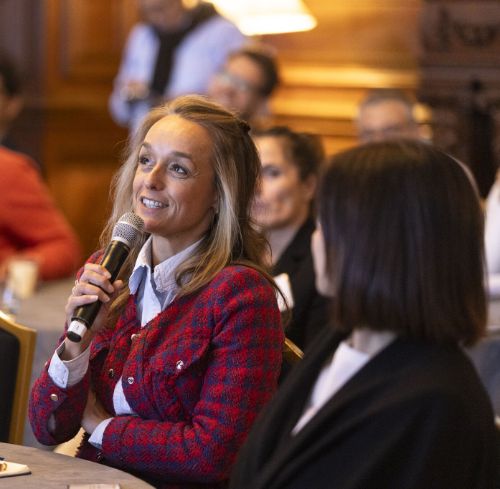
Where I get my inspiration
I get my inspiration from the combination of hospitality and lifestyle. I read a lot of articles, studies, and reports, and books and podcasts are steady sources. A favorite is The Stanza, where hospitality and fashion come together from an investor perspective. Since July, I’ve been following the MBA Design Leadership Program in London, which gives me a new perspective on how creativity and business strengthen each other. That mix keeps me curious, sharp, and continuously inspired.
The project I’m most proud of
The project I’m most proud of is ’t Huys. During COVID, we invited Amsterdam creatives to live, work, and create in our historic canal houses. That grew into fourteen unique suites, each designed within its own creative discipline. We gave the makers full freedom, so every suite tells an authentic story.
After COVID, we developed ’t Huys into a hybrid concept: suitable for stays, meetings, events, and bookings of entire floors. It feels like a boutique hotel within the hotel, where we showcase Amsterdam’s local culture and craftsmanship, such as in the Vincent van Gogh suite, with letters, museum editions, an immersive experience, and an exclusive museum visit. ’t Huys is creative, cultural, and commercially strong. It attracts partners and events like ADE and Amsterdam Fashion Week and performs better digitally than traditional rooms. It differentiates De L’Europe internationally—and that’s exactly why I’m so proud of it.
The trends I see in luxury hospitality marketing
I see three important trends. The first is multigenerational travel: not only millennials and Gen Z are traveling more, but multiple generations traveling together. The second trend is wellness. Wellbeing will only become more important in the coming years; people don’t just want to grow older, they want to live fitter and more consciously. The third trend is the members’ club psychology. Guests are looking for exclusivity, community, and the feeling of belonging somewhere. That is becoming increasingly decisive in the luxury experience.
Who has had the greatest influence on my career
Different people have shaped me in every phase of my career. Owners and managers who believed in me gave me the space to learn and grow. My business partner Tapio Pekelharing played a major role in that. We came from completely different worlds—he a lawyer, I a creative—and precisely because of that we learned an enormous amount from each other. My current managing director, Robert Jan, has also had a lot of impact. He has given me the space and trust to help drive the transformation of De L'Europe in recent years.
My ambitions for the coming years
My ambitions for the coming years are mainly about building something meaningful. I want to create impact in the industry that my heart belongs to, on the businesses and brands I work with, on the audience we reach, and also on myself. Hospitality is in my DNA, so my future will certainly remain connected to it. I have big ideas and dreams, and I feel I’m now at a point where I can truly make a difference. My experience before and after my agency has given me that awareness. Whatever I ultimately do, it has to be meaningful—for the industry, for people, and for my own development.
The three words that best describe me as a professional
The three words that best describe me are creative, strategic, and connecting. Creativity runs deep in me; people sometimes joke that I’m like a gumball machine: you put in a coin and ideas come out automatically. But creativity only works for me in combination with strategy. I like to think long-term, with a clear vision and direction. I’m also commercial. Ideas shouldn’t just inspire—they should also contribute to a healthy organization. And curiosity is almost automatically part of that. For me, that’s the foundation of creativity and growth.
How I decide whether a creative idea will work
With a new idea, my first response is often intuitive. I ask myself: is it unique, authentic, relevant, and sellable? As I do that, an initial concept automatically forms in my head. Only after that do I look at numbers and insights. But some ideas, like ’t Huys, can’t be fully calculated in advance. Then I rely on experience and that sixth sense the Fingerspitzengefühl every good creative needs.
Is creativity innate or can it be learned?
I believe creativity is partly innate, but you can definitely develop it. It’s an interesting topic, especially now with AI. A lot of people are afraid AI will take over creativity, but I don’t believe that. AI can support, accelerate, and replace junior work, but true creativity emerges in the human brain—through what you see, feel, smell, and experience. AI works with existing input; people create from intuition, experience, and emotion. You can train and professionalize that process, but its core lies within you.
My wish to inspire others
I hope to be an inspiration for the future of hospitality. As an “outsider” without a classic hospitality background, I joined at a crucial moment with a fresh perspective. My story shows that innovation often comes from outside, and that you don’t have to follow a traditional route to make an impact. I want to help people in the industry look differently, and motivate people from outside to step into this world, a world that touches all of us, every day.
Would you like to work at De L’Europe Amsterdam? Apply for one of our vacancies and become part of the team.