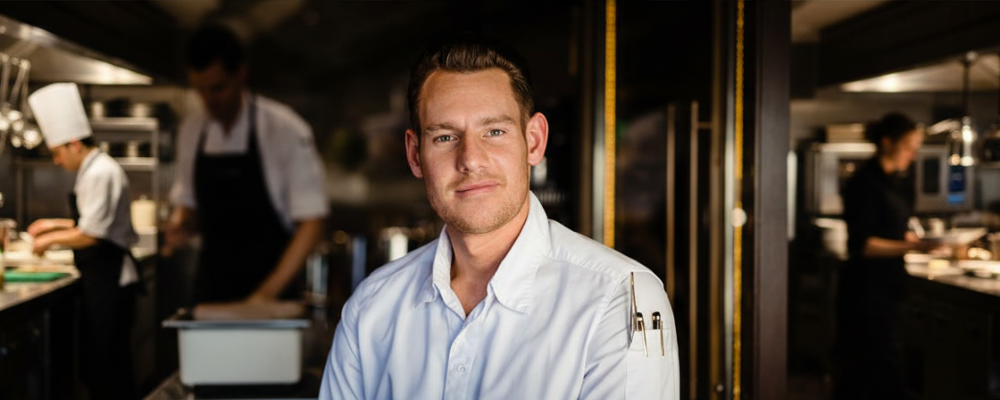
Tim Golsteijn: a kitchen built on precision, creativity, and teamwork
Tim Golsteijn is known for his refined, world-inspired cuisine at Bougainville, but his story begins surprisingly small: at a campsite just outside Amsterdam, where the spark for the profession ignited at an early age. That early curiosity grew into a career in which passion and precision are central: cooking as a craft, as teamwork and as a way to truly give guests something to take with them.
In this conversation, Tim takes you through the choices that shaped him, from his love for patisserie to his focus on seasonal products and building a strong kitchen culture from scratch. He also speaks openly about the future of fine dining, the pressure of rising costs and staffing, and why, at the highest level, creativity is required not only on the plate, but beyond it as well.
From campsite to kitchen
I knew at a young age that I wanted to become a chef. That started at the campsite when I was eight or nine years old. There was an older boy there whom I admired greatly and became good friends with. His parents owned hospitality businesses and he was already studying at the Hubertus & Berkhoff academy in Amsterdam, which inspired me enormously.
When I was twelve, that same friend asked if I could come and help wash dishes because they were short-staffed. That became my first side job in the kitchen and from that moment on things moved quickly. I wanted to earn money, partly because I had a scooter and a small speedboat, and my parents were very clear: if I wanted to go out on the water, I had to be able to pay for the fuel myself.
School was never really my thing; I mainly wanted to be active. I worked in a brasserie, first as a summer job, but because it went so well, it continued through the winter. Later, I also chose the Hubertus & Berkhoff programme and, alongside dishwashing, I increasingly helped out in the kitchen, for example on the cold section. From the very beginning, I felt: this is what I want.
Not a trick, but craftsmanship
Cooking is my profession and how I earn my living, but at this level it only works if you truly live for it. If it is “just a job”, you won’t make it. That is why it doesn’t feel like work to me. You spend so many hours together that the team naturally becomes a second family.
Some people call it art and say that makes you an artist. I see it differently. I am first and foremost a cook: I want something to taste incredibly good, and of course also to look good. Ultimately, for me it is about craftsmanship. You build that through years of experience, by continuously improving and developing your own style. Creativity is part of it, but the core is simple: with passion and precision, putting the best possible dish on the plate every single day.
The future of fine dining: adapt or disappear
Fine dining in the Netherlands has to reinvent itself. Everything is under pressure: staffing, costs and leadership styles, the approach of twenty years ago no longer works. With the VAT increase from 9 to 21 per cent, costs will rise. That makes you more expensive, and when you become more expensive, guests immediately expect more in return. This makes it harder to remain profitable, and you see restaurants changing or disappearing altogether.
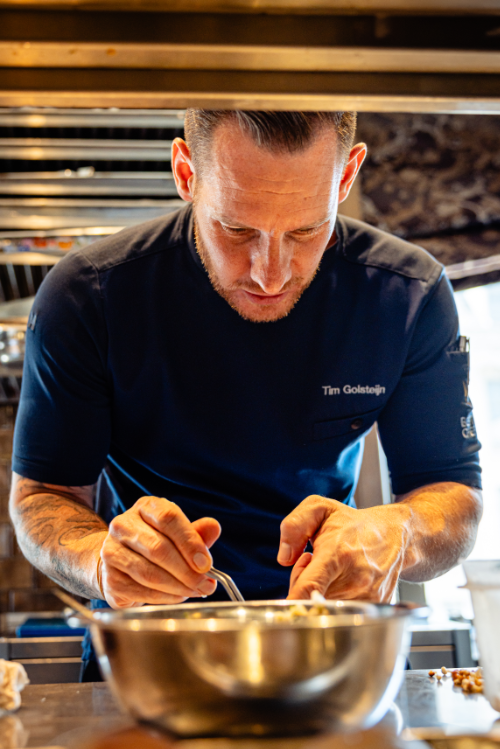
I believe there will always be a market for fine dining, but it is more challenging than it was a few years ago. You need to be creative not only on the plate, but also in the business itself: sharp on figures, budgets and labour costs. Working extremely hard simply to continue existing will be decisive for the future.
Energy from pressure and teamwork
I function best in busy situations, in what many people call “stress”. For me, that does not feel negative, but rather like tension and energy. That organised chaos keeps me sharp. When it is too quiet, I notice that I perform less well. I also get extra energy from unexpected things that come up, and especially from doing it together: switching quickly as a team, finding solutions and performing together.
During the day, things can be looser and more chaotic, but in the evening everything has to be tight and structured, because you are cooking for guests and the service simply has to be solid. Ultimately, for me it comes down to one thing: if guests are happy, I am happy too, that is what you do it for.
Chef and patissier: precision as the foundation
I see myself as a chef who is also a patissier. I briefly considered choosing patisserie full-time, but I wanted to keep doing the complete picture. My background in patisserie makes me all-round: I translate that precision and those techniques directly into my savoury dishes.
My love for patisserie developed after my education through my mentor Hans Heiloo, who took me to the Amstel Hotel / La Rive, where everything was still made fully in-house. I learned an enormous amount there.
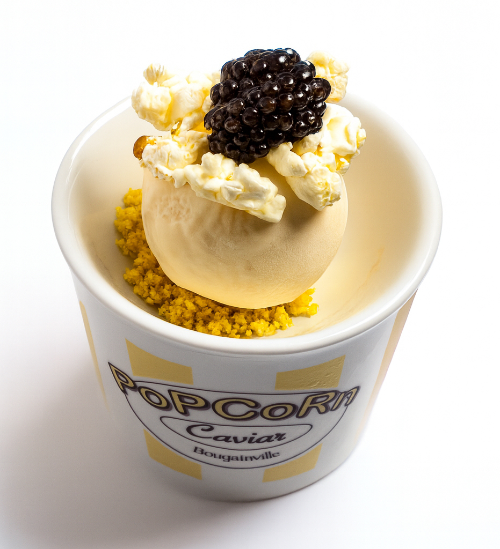
That is why desserts are also a strong point for us, despite not having a separate patisserie kitchen. A good example is our house-made popcorn and caviar: an iconic pre-dessert that shows how patisserie is woven into our style.
Cooking with memories as an ingredient
My cooking style is strongly intertwined with my personal memories. One of my earliest memories is from the south of France: the intense smell of rosemary. Years later, when I smelled rosemary in the kitchen, I was immediately taken back to that holiday.
That also applies to smaller, personal moments, such as the old-fashioned biscuit tin at my grandmother’s home in Amsterdam. Those are the kinds of memories I like to bring into the restaurant. For example, by serving biscuits in that recognisable tin. We have even recreated the well-known frog-shaped sweet. For me, that is such an iconic candy that it immediately carries a story.
I pass that way of thinking on to my team as well: inspiration comes from the past, but also from travel and recent experiences. I am always looking for that extra layer: where is a piece of yourself in the dish? Today’s guests do not only want something delicious, but also the story behind it, and at our level it is beautiful if you can also give them a memory or an emotion.
Shaped in practice: my first mentors
The foundation of who I am as a chef was laid by my first chefs and kitchens. In Ouderkerk aan de Amstel, with Peter Lute and his team, I learned at sixteen that cooking is beautiful, but above all extremely hard work. Everything was made from scratch, services were large and I learned how to really push hard — that became my foundation.
After that, I moved on to the Amstel Hotel, where I worked extremely long days and consciously chose to keep working instead of continuing my studies. I then built experience in other top-level establishments. Those early years, in which you are shaped and tested, made me the chef I am today.
Everything starts with the season
A new dish almost always starts with product and season for me. I do not understand why you would serve strawberries in winter or eat winter truffle from Australia when it is thirty degrees outside. No matter how beautiful the product is, to me it simply does not make sense.
That focus has become second nature through education, experience and responsibility, but also because it is logical: we have beautiful products close to home, such as fish from the North Sea. The shorter the chain, the fresher and better the product. Sometimes we make exceptions, such as carabineros or Wagyu, but the foundation remains local and seasonal, also as a concrete step towards sustainability.
Once I know which products are at their best, creativity follows naturally. Ideas, combinations and inspiration from memories and travels come together, and that is how a dish grows organically.
A world-inspired cuisine, shaped by travel
Travel inspires me very directly. When I see or taste something, the idea stays with me and later translates into a dish. The biggest influence at the moment comes from Asia, mainly because I have been there the most. Thailand is very close to me in terms of flavours; you can truly wake me up for a good curry. You can see that reflected in our menus and cooking style: Asian flavours suit the way I taste and think. I am becoming increasingly curious about South America. I was briefly in Mexico and found it incredible, and I would love to return because there is still so much to discover.
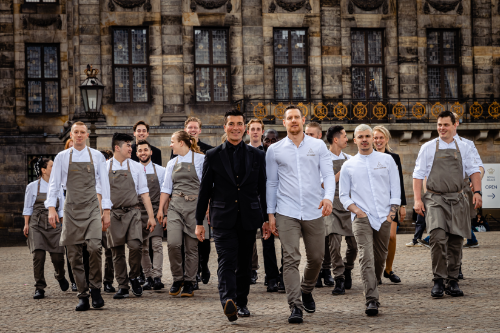
My international kitchen also comes from my background. Growing up in Amsterdam in a multicultural environment, an Indonesian neighbourhood, stamppot at home and couscous at friends’ houses, it felt natural to combine world influences. Travel is now a true passion: I always return with new inspiration, and I encourage that same curiosity in my international team.
When something truly fits Bougainville
Whether an ingredient fits Bougainville is not determined by a fixed checklist. I do what I want and stay true to my own style. The only constant foundation is season and product; beyond that, I deliberately leave combinations and ideas open, because creativity has no hard boundaries for me.
I sometimes jokingly call it not “fusion”, but “confusion”: we mix influences and techniques without needing to fit into a single box. When something feels too trend-driven or not personal enough, I go by instinct: does it fit us, does it fit me, and does the story on the plate make sense? If it is just hype, I leave it.
Leading with energy and trust
Creativity starts with energy. Travel helps, but especially actively stimulating the team: tasting, sharing ideas and challenging each other. We are a small team, so you quickly start thinking in the same direction and continue developing, and doubt is part of that.
I am very present in the kitchen, involved, and I consciously lead differently from the “old school”: not tearing people down, but explaining how things can be better. Enjoyment supports development, but the bar remains high, service has to be solid every single day. That is possible without shouting, and with clarity, trust and energy.
Building a kitchen culture from scratch
When I started at TwentySeven/Bougainville, we truly began from zero. After the departure of Pascal Jalhay, my initial focus was simply ensuring that there was a team at all, and during the first year I worked on that day in, day out.
My focus was clear from the start: not just a team, but a family. Through respect, trust and involvement, people stayed longer and a strong culture developed. After the Michelin star, attracting talent became easier and applications now come in internationally, but the core remains the same: creating a place where people want to stay and grow.
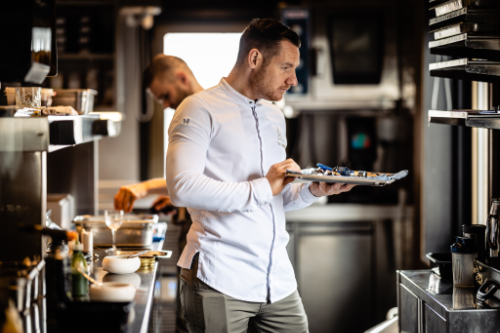
Growth starts at the bottom and with the basics
For me, it starts with mindset, and only then does technique follow. If you want to become a top chef, this profession has to be your passion and you must be willing to push hard, just like in elite sport. I now see too often that young cooks do not master basic skills. I ask for something simple like stamppot, and it turns out that even boiling potatoes is difficult. That is why I say: start at the bottom and make sure your foundation is solid.
Technique is built from the basics. Those basics are increasingly skipped because they are seen as “boring” or “too classically French”. But if no one makes jus and stocks from scratch anymore and everything is bought in, the craft and the understanding of why you do things disappears. After the foundation, flavour development follows naturally, but that takes time: tasting a lot, experimenting and learning to recognise exactly what you are tasting.
Trust and loyalty as the true measure
For me, the greatest compliment is not a pat on the back, but genuine friendship. That people who have worked with me still stay in touch after they leave, still call me “chef” and come by. Then I know this is not superficial, this is a family bond.
My leadership is about trust and loyalty: being there for each other, also outside of work, and going through fire for one another. That feeling is far more valuable to me than any formal compliment.
Continuing to grow without chasing trends
I get a lot of energy from travel, events and encounters. My network and everything I learn through it inspire me and keep me creative. That variation is essential, because I would get bored quickly if I did the same thing every day. The combination of making guests happy and continuing to challenge myself keeps me motivated in this profession.
I continue to grow by staying open to new things. In addition, you learn every day in the kitchen through your team, social media, techniques you pick up and by remaining curious. As a chef, I know you are never done learning.
I mainly follow my own path and do not blindly chase trends. Sometimes something suddenly becomes a hype while we have been doing it for years, such as popcorn ice cream with caviar. Conversely, I deliberately leave trends alone when everyone else is doing them, even if they are tasty. Knowing trends is useful when you are an entrepreneur, but at my level it is mainly about your own vision and development. Trends may play a role, but they should never be leading.
The advice I would give my younger self
If I could give my younger self one piece of advice, it would be that work is not everything. I achieved everything by giving one hundred per cent and I have no regrets about that, but at times I was so extremely focused that I neglected parts of my social life, family and relationships. If I had slowed myself down a little more occasionally, it would have given me more balance personally.
That is exactly why I consciously look for relaxation outside the kitchen, through sport and motorcycling, physical effort that mentally disconnects me, because I am normally busy with work twenty-four seven, with my phone, emails and ideas constantly running. If I had not become a chef, I am quite sure I would have done something in sport. I used to be very active (football, tennis, karting, karate) and highly competitive, but irregular hospitality hours made it difficult to combine everything.
Entrepreneurship and dreams for the future
My biggest ambition remains entrepreneurship: one day opening my own restaurant and truly building something based on my own vision. In addition, I have had a dream since I was young to do something with ice cream, for example opening an ice-cream parlour. I have joked before about an ice-cream shop with Michelin-level quality, like the inspiring examples you see with the Roca brothers in Girona and similar concepts abroad.
Product development also appeals to me: creating and producing my own products. In the coming years, I want to explore this further, discover what suits me and gradually determine which direction I want to take.
Would you like to work at Hotel TwentySeven in Amsterdam? Then take a look at the vacancies here.