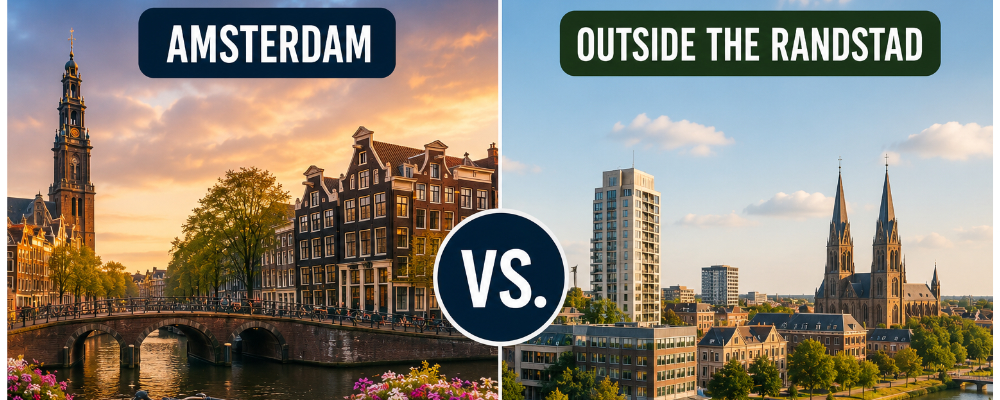
Working in hotels in Amsterdam vs. outside the randstad

Anyone looking for a job in the hotel industry will soon face a choice: do you work in Amsterdam, where most hotels are located, or choose a hotel outside the Randstad? At first glance, the differences may seem limited. After all, the Dutch hospitality collective labour agreement applies nationwide, meaning base salaries are largely the same across the country.
However, recent figures show that the final decision involves much more than just your payslip. Housing costs, career opportunities, labour market conditions and the day-to-day working environment all play an equally important role in determining how attractive a hotel job really is.
For many hotel employees, the decision therefore comes down to one question: do you choose maximum career opportunities, or greater financial freedom and a better work-life balance?
Base salaries are largely the same everywhere
A common assumption is that hotel employees in Amsterdam earn considerably more than their colleagues elsewhere in the Netherlands. In practice, this is not necessarily the case for operational roles. The hospitality collective labour agreement is set nationally, which means that base salaries for many positions are the same whether someone works in Amsterdam, Eindhoven or Maastricht.
That does not mean there are no regional salary differences at all. Salaries for management roles and head-office positions may be higher in the Randstad. More international hotel groups, regional offices and specialist positions are based there, particularly in areas such as revenue management, sales, marketing, finance and human resources.
Greater competition for experienced professionals and the higher cost of living may also contribute to higher salaries.
Differences can also arise through secondary employment benefits. Large international hotel groups regularly offer additional benefits such as:
education and training programmes;
employee discounts on hotel stays;
travel expense reimbursements;
referral bonuses;
career development opportunities within the hotel group.
For many operational roles, the collective labour agreement therefore remains the starting point. Once you move into management or a specialist head-office position, salary differences between Amsterdam, the Randstad and the rest of the Netherlands may become more noticeable.
Amsterdam offers the most career opportunities
Anyone looking to progress quickly will simply have more options in Amsterdam. The capital has more than 540 hotels and approximately 41,000 hotel rooms, making it by far the largest hotel market in the Netherlands.
This scale creates a broad employment market. In addition to traditional housekeeping and front-office roles, there are many specialist positions available, including:
Revenue Management;
Sales & Marketing;
Almost all major international hotel groups are also represented in Amsterdam. This allows employees to move relatively easily into leadership positions or gain experience across different hotel concepts.
The guest mix also differs considerably. Amsterdam records tens of millions of tourist overnight stays each year and attracts visitors from all over the world. This means working in an international environment where English is often just as important as Dutch.
Working outside the randstad often leaves more money in your pocket
While Amsterdam stands out for its career opportunities, cities such as Eindhoven and Maastricht often have the advantage when it comes to affordability.
For many hotel employees, the largest expense is not work-related but housing-related: rent. This is where the differences are most significant.
Category | Amsterdam | Eindhoven | Maastricht |
|---|---|---|---|
Average rent for a room | €845 | €531 | €525 |
Average rent for a studio | €1,028 | €790 | €667 |
Average rent for an apartment | €1,658 | €1,005 | €934 |
Based on an indicative net monthly income of approximately €2,263, a hotel employee in Amsterdam would spend more than one-third of their income on a room alone. For an apartment, this could rise to more than 70% of net salary. Outside the Randstad, these percentages are considerably lower.
This difference has a direct impact on purchasing power. Employees in Eindhoven and Maastricht often have several hundred euros more left each month for groceries, transport, savings or leisure.
For starters, students and young hotel professionals in particular, this can be a decisive factor.
Working culture also varies by region
It is not only the cost of living that differs. Day-to-day work can also vary significantly from one region to another.
In Amsterdam, the focus is strongly on international tourism. Hotels welcome large numbers of foreign guests, city-break visitors and business travellers. As a result, the work is often dynamic, fast-paced and highly international.
Eindhoven has a different atmosphere. Thanks to Brainport and the presence of major technology companies, the guest mix includes business travellers, conference attendees and a growing number of leisure tourists.
Maastricht, by contrast, has a distinct tourism-focused profile. The city attracts many visitors for city breaks and weekend trips. This creates a relatively stable leisure market in which hospitality and personal service play a central role.
What about job security?
Differences in employment conditions are relatively small because the hospitality collective labour agreement applies throughout the Netherlands.
Among other things, this means that:
work schedules should generally be announced three weeks in advance;
on-call employees should normally be scheduled at least 24 hours in advance;
after twelve months, employers must offer a fixed number of working hours based on the employee’s average hours worked.
Even so, job security does not feel the same everywhere. In Amsterdam, an unexpected reduction in working hours can lead to financial difficulties more quickly because of the high cost of housing. Outside the Randstad, fixed living expenses are generally lower, giving employees more financial flexibility.
Amsterdam or outside the randstad: which suits you best?
There is no single right choice. It mainly depends on your personal circumstances and ambitions.
Choose Amsterdam if you:
want to progress quickly;
want to gain international work experience;
want to work for a major hotel group;
value having a wide range of career paths;
already have housing or can manage the high cost of living.
Choose a hotel outside the Randstad if you:
value lower housing costs;
want to retain more disposable income;
prefer working in smaller teams;
are looking for a better work-life balance;
want to live independently sooner.
Conclusion
Anyone looking only at salary will see little difference between Amsterdam and the rest of the Netherlands. The hospitality collective labour agreement ensures that base salaries are largely the same nationwide. The real differences lie in everything surrounding that salary.
Amsterdam offers the most extensive career opportunities, an international working environment and a wide variety of hotels. However, housing costs are considerably higher, meaning a large share of employees’ income goes directly towards rent.
Outside the Randstad, career opportunities may be less abundant, but this is balanced by a much more favourable cost of living. Lower housing costs often leave hotel employees with more disposable income each month.
For those who want to build a career in international hospitality, Amsterdam remains an excellent choice. Those looking for a healthier balance between income, housing costs and quality of life may find it more easily in cities such as Eindhoven or Maastricht.
Ultimately, the most attractive place to work is determined not by salary alone, but by the combination of career opportunities and disposable income.